The build-versus-buy debate, revisited
SaaS Is Dead? Please.You're Missing the Point (Again).
I keep seeing the same hot take: "SaaS is dead because anyone can build apps with AI now." No. That is not how this works. The argument misses what made SaaS useful in the first place, and why it still matters.
No one ever cared who owned the code
It is easy to forget this: SaaS did not take off because companies suddenly became excited about renting software. It took off because companies were tired of owning the operational mess that came with on-premises software.
IT departments were not made obsolete. The delivery model changed. Salesforce, Workday, ServiceNow, Microsoft, and others took proven, packaged applications and delivered them as managed services.
The real transformative shift? Total cost of ownership.
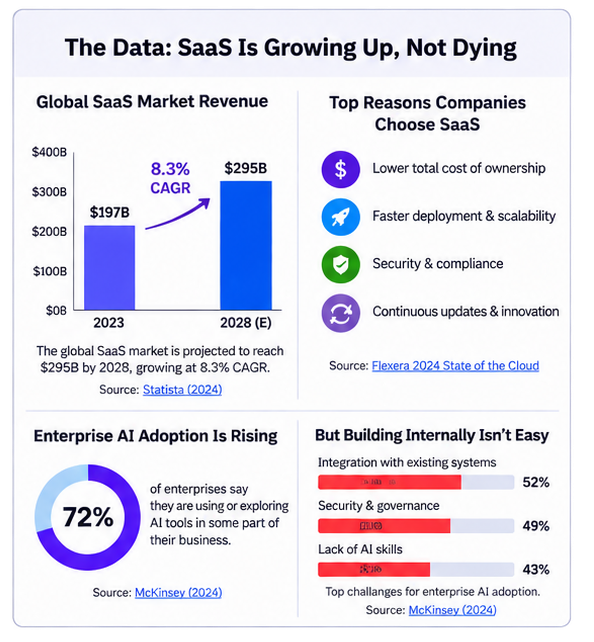
SaaS won because it reduced the hidden costs of running software: infrastructure, upgrades, security, backups, disaster recovery, compliance, integrations, and the people needed to keep all of it working.
Specialization matters. Does Ford want to spend millions building and hosting a CRM for 30,000 employees, or would it rather make cars?
SaaS lets companies buy specialized, continuously improved software so they can focus their own teams on the work that sets them apart.
AI changes the moat, not the value proposition
AI is lowering the barrier to building software. That changes the competitive moat for SaaS companies. Startups can build faster, iterate more cheaply, and put pressure on incumbents.
It does not change what the customer buys: outcomes, reliability, scale, security, and a lower total cost of ownership.
If anything, AI adds another layer of operational work for enterprises. Teams now have probabilistic systems to evaluate, model output to govern, data access to secure, integrations to maintain, and rapidly changing components to manage. That is more complexity, not less.
The CEO distraction cycle
There will absolutely be app-building CEOs telling their IT teams, "Go build us AI apps." The novelty of fast, low-code creation is real.
Internal tools can solve a tactical need here or there. They do not replace the product depth, compliance work, road maps, ecosystems, support, and global scale that mature SaaS platforms provide.
Businesses will experiment. Some experiments will become useful internal systems. Most companies will still buy software when a focused vendor can deliver a better outcome at a lower lifetime cost.
Questions people are asking about AI and SaaS
Is SaaS dead because of AI?
No. AI is changing how software is built, priced, and used, but it does not remove the need for reliable systems, secure data, support, integrations, or accountable vendors. IDC describes SaaS as being disrupted and reworked, not eliminated.
Will AI agents replace SaaS products?
AI agents may replace parts of the interface and reduce the number of people clicking through routine workflows. They will still need trusted systems of record, permissions, APIs, and business rules behind them. Some SaaS products will disappear. Others will become the infrastructure that agents use.
Is custom AI software cheaper than buying SaaS?
It can be cheaper to prototype. The comparison changes once the custom application needs hosting, security, backups, maintenance, integrations, support, and an owner. Buyers should compare the full lifetime cost and risk, not the cost of generating the first working version.
What will successful SaaS companies sell in the AI era?
They will sell dependable outcomes. Product depth, trusted data, workflow knowledge, security, and accountability will matter more as basic features become easier to copy. The interface and pricing model may change, but customers will still pay someone to make the system work.