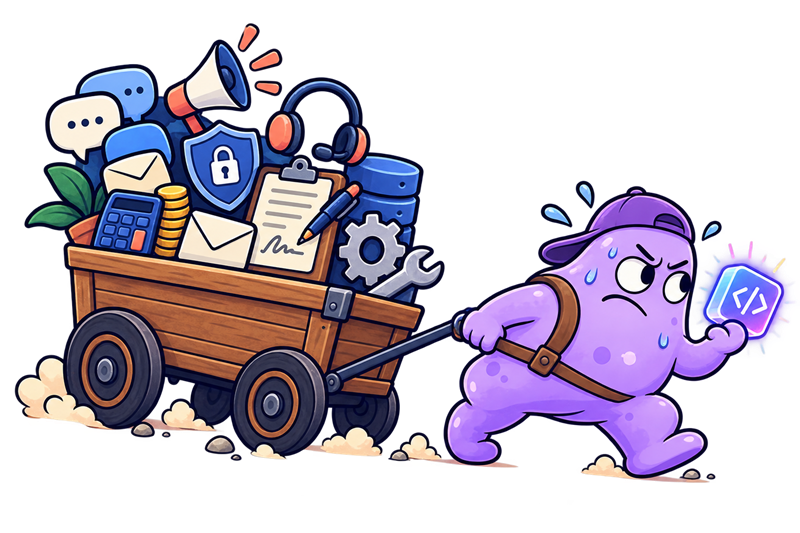
Cheaper software is not a cheaper company
The Code Got Cheaper.The Company Didn't.
Velaro and StatusCast each took me nearly a year to build by hand. AI could compress that work today. It could not tell me whether either product deserved to become a company.
I remember what a first version used to cost
I wrote Velaro and StatusCast entirely by hand. Each first version took close to a year to build before it had a real chance to meet the market.
That was not a romantic year of tinkering. It was time, money, and risk accumulating every day. By launch, I had already made hundreds of decisions about a customer I was still trying to understand. If the premise was wrong, I could not shrug and throw away a weekend prototype. I had a year of my life tied up in it.
That is why the research had to come first. When code was expensive, an uninformed guess was an excruciating way to start a company.
AI removed the excuse to research later
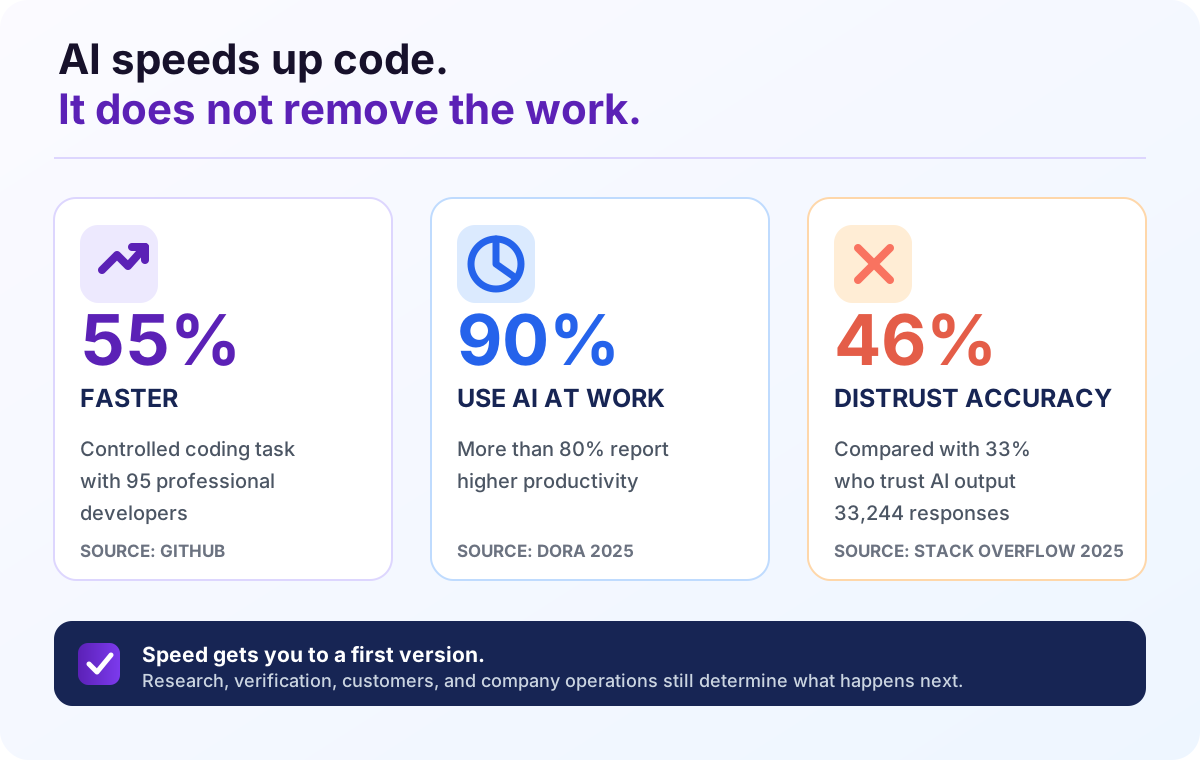
The change in development speed is real. In a controlled GitHub study of 95 professional developers, the group using Copilot completed a coding task 55 percent faster.
DORA's 2025 research found that 90 percent of technology professionals use AI at work and more than 80 percent believe it has increased their productivity. It also found that higher AI adoption was associated with more delivery throughput and more delivery instability.
Speed is not certainty. In the 2025 Stack Overflow Developer Survey, 46 percent of respondents distrusted the accuracy of AI tools while 33 percent trusted them.
A founder can now turn an idea into a plausible application in days or weeks. That is wonderful. It should make experimentation cheaper and make bad ideas easier to discard.
Instead, some founders are learning the opposite lesson. They assume that because the application was easy to create, the company will be easy to build.
The expensive work moved. It did not disappear.
A working product still needs a customer who cares. That customer has to understand why the product is different, trust it with real work, get through onboarding, and receive help when something breaks. Someone has to find that customer in the first place.
Then come the parts that demos avoid: permissions, security reviews, billing failures, contract negotiations, odd integrations, support coverage, and all the edge cases created by actual customers.
AI can help with every one of those jobs. It does not decide which market is worth years of your attention, and it does not make customers appear.
Use the savings before you build
If AI gives you months of development time back, spend some of it learning. Study competitor reviews and support complaints. Understand how buyers describe the problem, what they already pay for, which workaround they hate, and where they go for advice.
Then use fast development to test an informed position. Put a narrow solution in front of the right people. Watch what they do. Throw it away if the evidence says you were wrong. Cheap code is most useful when you are willing to discard it.
Questions founders are asking about AI and SaaS costs
Does AI make a SaaS product cheaper to build?
Yes, especially during prototyping and early development. In GitHub’s controlled study, developers using Copilot completed a coding task 55 percent faster. That is meaningful savings. It does not include customer research, distribution, support, security, infrastructure, or the years of maintenance that follow the first release.
How much does it cost to build a SaaS product with AI?
There is no useful universal number. A founder may produce a convincing prototype for little more than the cost of AI tools and hosting. A dependable commercial product still has costs tied to its scope, data, integrations, compliance requirements, customer acquisition, and support expectations.
Is coding the hardest part of starting a SaaS company?
Coding can be brutally hard. Velaro and StatusCast each took me close to a year to build by hand. After launch, the difficulty changes. Finding customers, earning trust, supporting them, and making thousands of small product decisions can last far longer than the initial build.
What should a founder research before building SaaS?
Start with the buyer’s painful workflow, current alternatives, willingness to pay, purchasing process, and the places where those buyers already look for help. Talk to potential customers and study competitor reviews. Use AI to test what you learn quickly, not to avoid learning it.