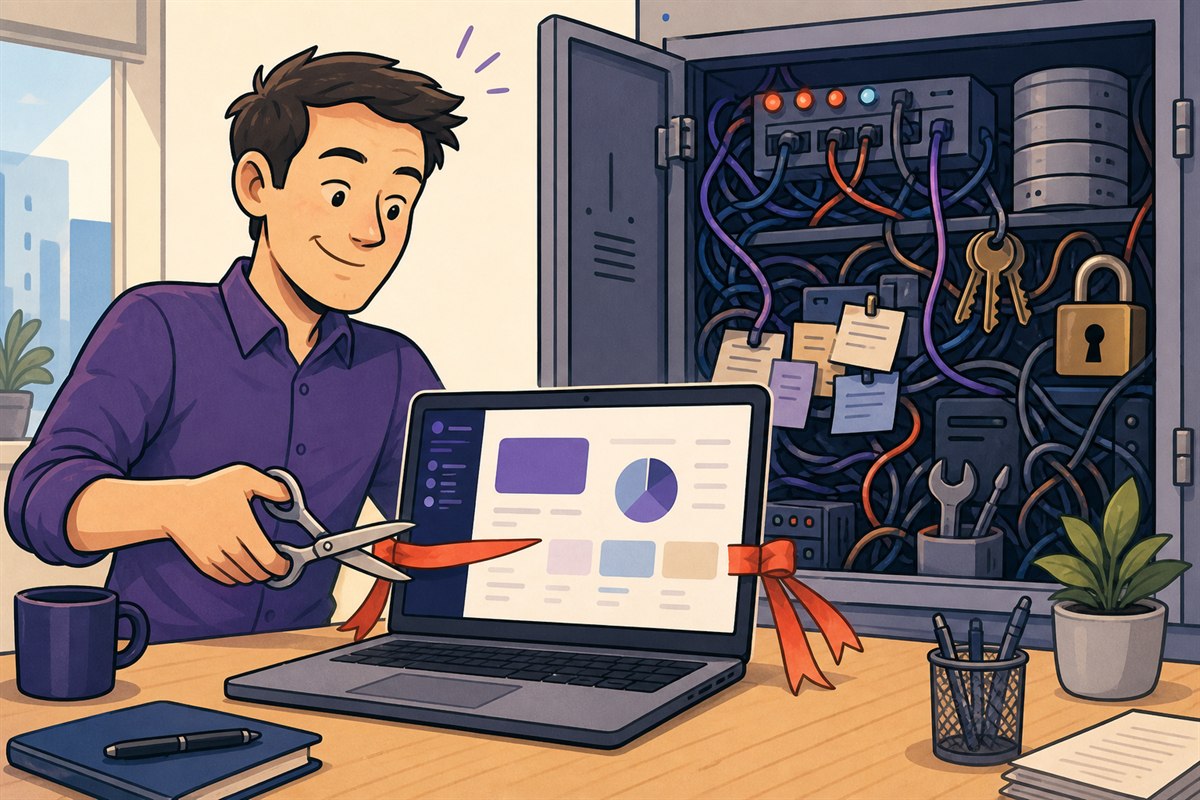
Congratulations on the app. Who owns it on Tuesday?
AI Is Creating a Generation ofAccidental Software Owners
An employee solves a problem with AI and shares the link. Five minutes later, the company owns production software nobody planned to maintain.
The celebration happens too early
Someone in finance, marketing, support, or operations gets tired of waiting for an internal tool. They open an AI builder, describe the problem, connect a spreadsheet or database, and have something useful by the end of the day.
The demo works. A few coworkers ask for access. The person who built it gets congratulated for moving quickly. There is probably a Slack thread containing several fire emojis.
Then everyone moves on without asking the boring questions. Who controls the permissions? What data is being stored? Which systems does it depend on? Who answers the support messages? What happens when the person who built it changes jobs, forgets the password, or simply stops enjoying their new unpaid career in software support?
The application may have been created casually. The responsibility becomes real the moment another employee depends on it. Adoption is the line between a clever experiment and a company problem.
This is already happening at scale
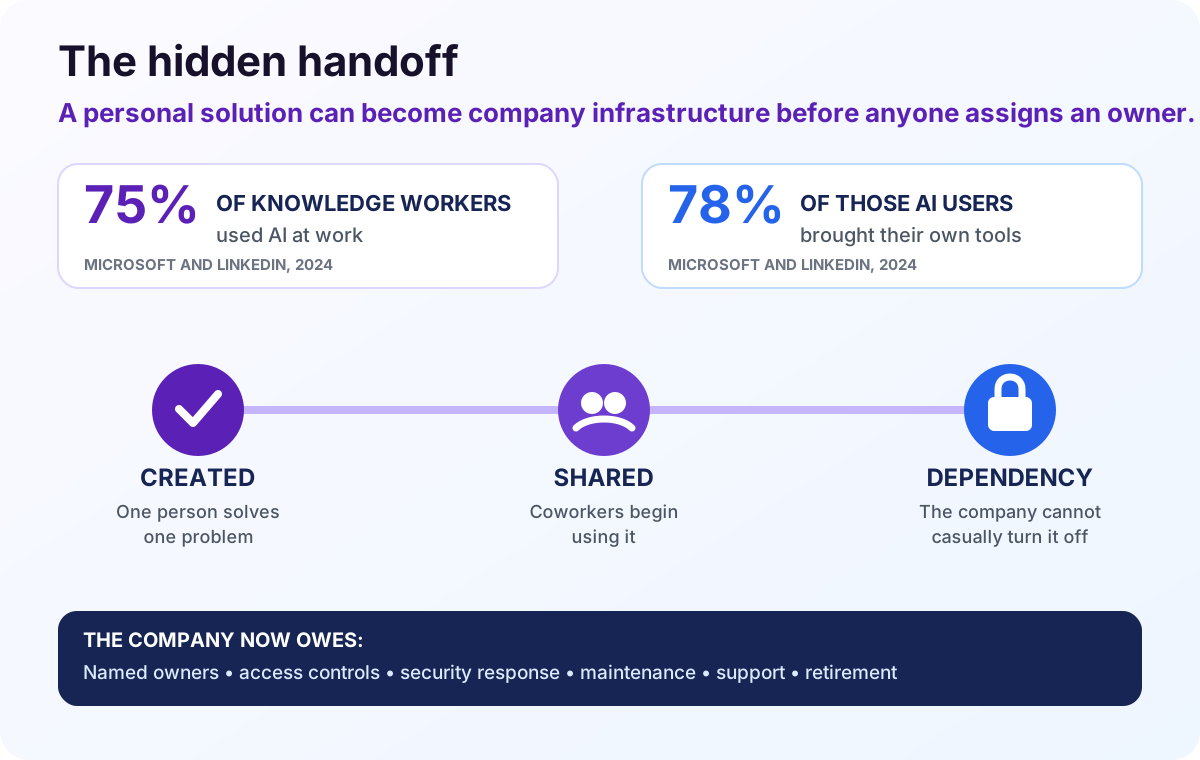
Microsoft and LinkedIn's 2024 Work Trend Index, based on 31,000 people across 31 countries, found that 75 percent of knowledge workers used AI at work. Among those users, 78 percent brought their own AI tools rather than waiting for their employer.
That same instinct now applies to software. People do not need to open a procurement request or wait for an engineering sprint. They can make the thing themselves, which is both genuinely useful and how every good horror movie begins.
Microsoft's own Power Platform governance guidance warns that growing adoption produces ownerless and unused apps. When a maker leaves, the apps and workflows they created can become ownerless. Widely used apps that skip proper lifecycle management create business continuity risk.
Every shortcut creates a list of obligations
The tool needs credentials. Those credentials need to be stored and rotated. The data needs rules about who can read, change, export, and delete it. Every integration can change without warning. Every dependency can introduce a vulnerability. Someone has to test updates, investigate failures, and decide when the application should be retired. "It is just an internal tool" does not perform any of those jobs.
NIST's Secure Software Development Framework makes the point plainly: security practices belong throughout the software lifecycle. They include preparing the organization, protecting software and its components, producing secure releases, and responding to vulnerabilities after release.
AI can help perform those jobs. It cannot accept accountability for them.
The creator is not automatically the owner
The employee who solved the initial problem may have no budget, authority, or interest in running production software. They may not know that the app has quietly become part of payroll, customer onboarding, reporting, or another process that cannot simply stop on Tuesday morning. "Ask Melissa, she built it" is not an operating model.
An internal application needs a named business owner and a named technical owner. It needs an inventory record, an access policy, a support path, and a retirement plan. If nobody is willing to accept those jobs, the company is not ready to depend on the application.
Ask five questions before sharing the link
- Who owns the business process and the technical system?
- What data, credentials, and permissions does it use?
- What breaks if the app stops working tomorrow?
- How will ownership transfer when its creator leaves?
- Who decides when to repair, replace, or retire it?
If the answers are vague, the application is still a prototype. Treating it like production software does not make it one.
Questions companies are asking about AI-built internal apps
Who owns an internal app created by an employee?
The company needs to name both a business owner and a technical owner. The employee who built the app should not inherit permanent responsibility by accident. Ownership includes access decisions, funding, support, maintenance, risk acceptance, and the authority to retire the application.
What happens when the creator of an internal app leaves?
Without a planned handoff, credentials can expire, integrations can break, and nobody may understand the application’s data or dependencies. Microsoft’s Power Platform guidance specifically warns that apps and workflows can become ownerless when their maker leaves. Transfer ownership before the employee’s access is removed.
Are AI-built internal tools secure?
They can be, but generating a working app does not prove it is secure. The company still needs to review authentication, permissions, secrets, data storage, dependencies, logging, and vulnerability response. The level of review should match the sensitivity of the data and the damage a failure could cause.
How should companies govern vibe-coded apps?
Keep an inventory, require named owners, classify the data each app touches, and set review requirements before broader use. Every production app also needs a support path, monitored dependencies, a handoff process, and a retirement plan. Fast creation should shorten the path to testing, not bypass operational controls.