AI and the future of independent software
Big AI Is Coming for Your Software
The company selling you the model is already building its own apps. Imagine what happens when it stops selling you access.
The big AI companies are coming for your software.
They have one job: kill every application they can replace with their own.
And if your product depends on their models, you're paying them while they figure out how to do your job.
They're building the apps themselves
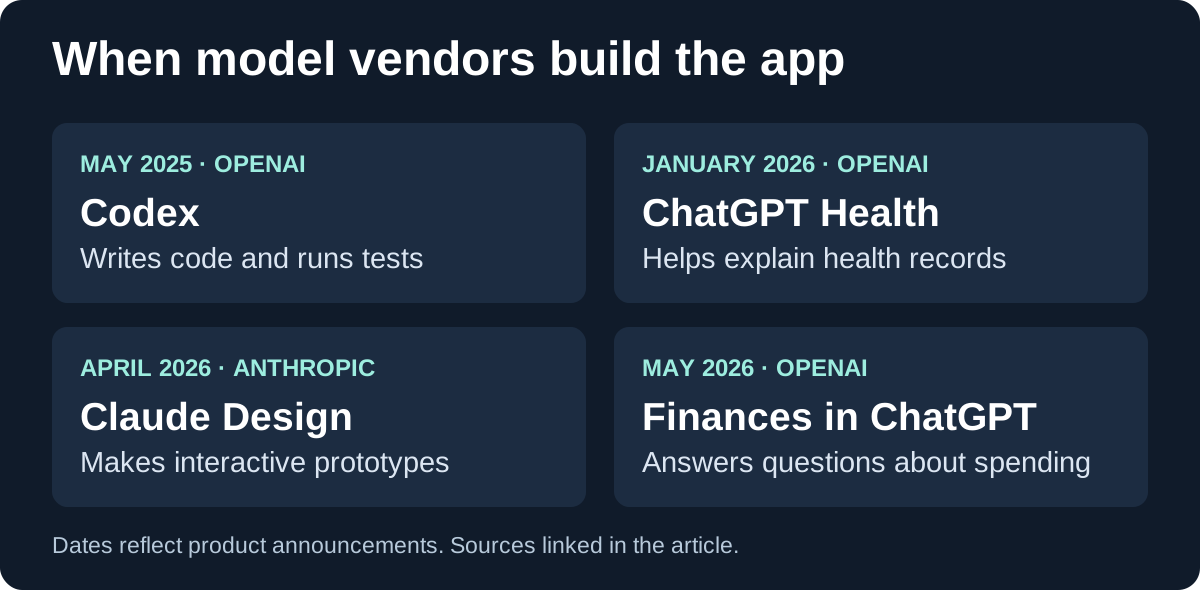
Anthropic used to be the company a design tool could call for help generating a mockup. Now Anthropic makes Claude Design. You can describe a product screen, turn it into an interactive prototype, and edit it there. Anthropic even describes handing designs off to Claude Code for implementation.
OpenAI built Codex to work on your codebase, write patches, and run tests. It also built Health in ChatGPT, which can use connected health information to help people make sense of their records. Finances in ChatGPT can connect to financial accounts and answer questions about spending using a person's own transactions.
These are products sold by the companies that sell the models. A design tool pitching an AI prototype feature now has to explain why the customer should open another app for the same job. That conversation gets shorter every time Claude Design does something the customer used to pay extra for.
How good does their app have to be?
Maybe you think their apps are bad. Fine. How good does the budgeting feature inside ChatGPT have to be before someone cancels the budgeting app they open twice a month?
Think about the customer who wants to know why their credit card bill jumped this month. They want to find the three charges that explain it and get on with their day. Your app can have a better dashboard, a dozen ways to edit categories, and a report that beats anything ChatGPT can produce. That customer might still ask ChatGPT first. Once they have the answer, your better dashboard is waiting for a visit they're no longer planning to make.
Plenty of people will still pay for detailed budgeting. The painful question is how many of your paying customers use enough of your product to belong in that group. If most of them come for one job the model company can bundle into a subscription they already pay for, you're fighting over the part of the bill they can cancel.
Then they stop selling you the model
My prediction is that the big AI companies will stop giving independent apps API keys for their models. If your customers want to use those models, they'll have to go through ChatGPT, Claude, or whatever app the model company puts in front of them.
The API business gives the providers a reason to keep selling access. Every product built on a model can send paid traffic to that model for years. A provider could keep selling it and go after your customers at the same time. My bet is that when a provider thinks it can make more by taking the customer directly, some of those independent products will find out how much their access was worth to the company on the other end.
Today you can read OpenAI's deprecation notices and see what happens when a particular model or endpoint reaches its shutdown date. The list names replacement options for many retirements. I'm talking about a different decision. The company drops direct access for independent apps and sends the customer to its own product. That's my forecast, not an announced shutdown.
Picture getting that email. Your access ends in 90 days. Every customer who bought your software for what that model can do is still expecting it to work on day 91. The company cutting you off already has somewhere for them to go. How many of them will wait for you to rebuild?
Find out what stops working on day 91
Take the workflow customers are most likely to cancel over and run it in a test environment with your main provider disabled. Use the real workflow all the way through, from the customer's first action to whatever they need to save, send, or approve.
- Check what goes missing with the model. Can you still retrieve the files, job history, or customer preferences the provider stores for you? Can your team recreate the tool calls, review steps, and permissions?
- Try a second provider or an open-weight model on representative cases, including the awkward ones your current setup only just gets right. Record incorrect results, review time, and cost per completed job.
- See what customers can finish without AI. If a manual path exists, time it. If the answer is that support will do the work, estimate how many jobs support can actually handle.
A second key in an environment variable won't tell you whether those customers can finish their work. A completed job on a fallback will. It might tell you something worse, too. You can switch models next week, but your customers can switch products this afternoon.
Questions about AI API access and vendor lock-in
Are OpenAI and Anthropic shutting down their APIs?
OpenAI and Anthropic offer developer APIs. Both publish notices when they retire specific models or endpoints. A broader cutoff for independent apps is the author’s prediction, not an announced policy.
What is AI vendor lock-in?
AI vendor lock-in is the cost and difficulty of moving a workflow to another model provider. It can come from model behavior, prompts, tool calls, stored files, conversation history, or a feature only the original provider offers.
How can a SaaS company prepare for an AI API shutdown?
Map the paid workflows that depend on the provider. Test a replacement against real acceptance criteria, verify what data you can export, and rehearse how customers would complete their work if the original provider became unavailable.