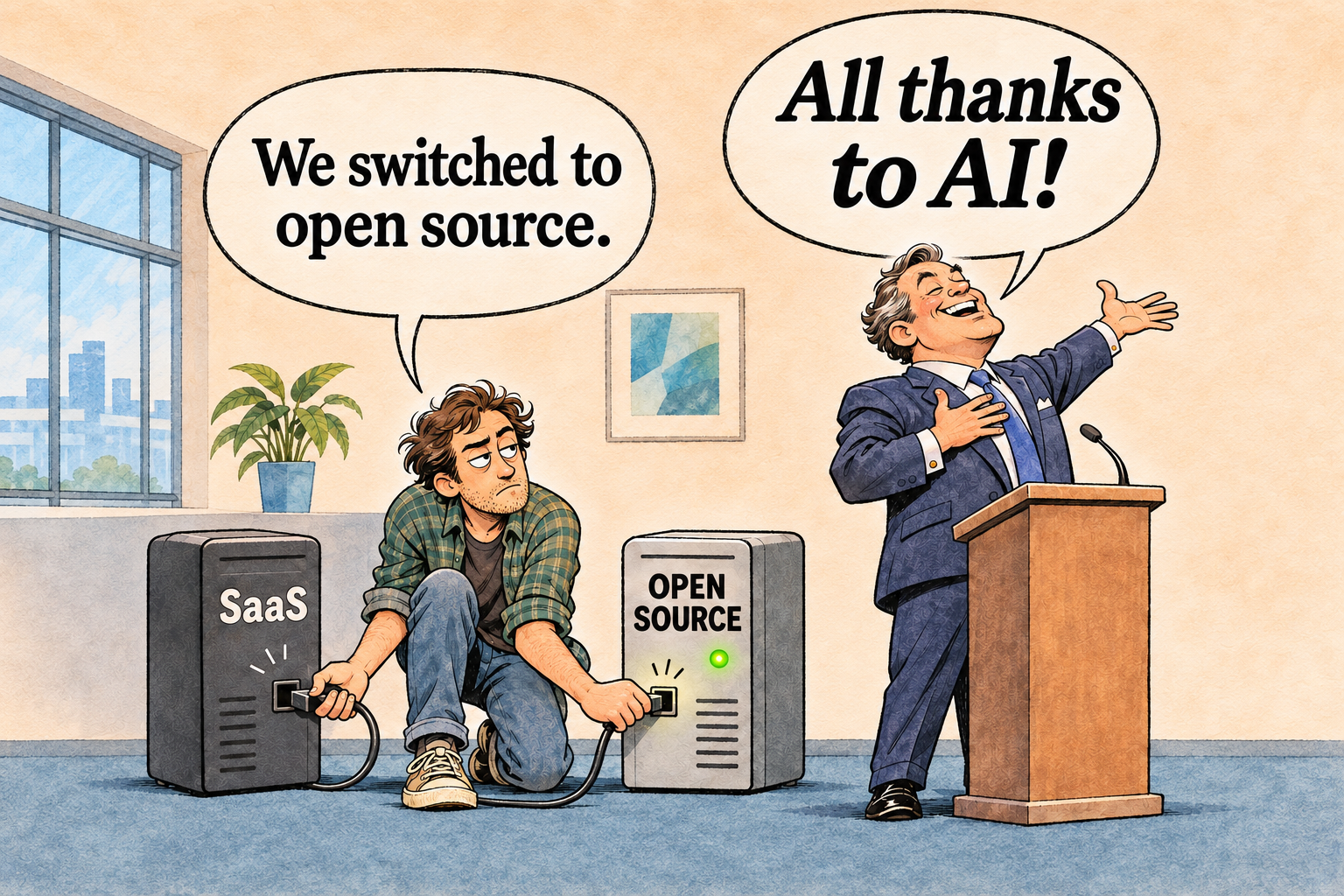
The oldest software decision in a brand-new costume
You Switched to Open Source.Why Is AI Taking the Victory Lap?
Replacing SaaS with open source can be smart. Calling the migration an AI revolution is comical.
The press release says AI killed another SaaS subscription.
Engineering says the company migrated to open source, rebuilt the integrations, consolidated the data, and brought the operation in-house.
Somehow the robot still gets the photo op.
THE CLAIM
Replacing SaaS with open source can be smart. Claiming AI caused the whole thing is comical.
Open source was replacing commercial software before every technology decision needed an AI subplot. AI may make the move cheaper. It did not invent the option.
The migration can be excellent. The origin story can still be nonsense.
ON THE RECORD
Klarna dropping Salesforce became a clean story about AI replacing SaaS. Then the architecture diagram showed up.
- Klarna consolidated data from several SaaS systems onto an internally developed technology stack.
- It used Neo4j and other tools, then let its internal AI work with the combined knowledge.
- Cursor helped the company build interfaces and interactions more quickly.
- CEO Sebastian Siemiatkowski later clarified: “We did not replace SaaS with an LLM.”
He also said he doubted most companies should follow Klarna's path. That sentence did not travel nearly as far as the revolution.
WHAT AI ACTUALLY DID
AI can reduce the labor around the decision.
- It can help a team understand unfamiliar code.
- It can write migration scripts and connectors.
- It can translate old business rules, generate tests, and build internal interfaces.
- It can help diagnose the first wave of things that break.
That is real leverage. Work that once made self-hosting impractical may now fit inside a reasonable budget and schedule.
AI did not create the mature open-source project. It did not produce the years of bug reports, documentation, security fixes, community arguments, and maintenance that made the project usable.
It also did not accept responsibility for Monday morning.
THE NUMBERS
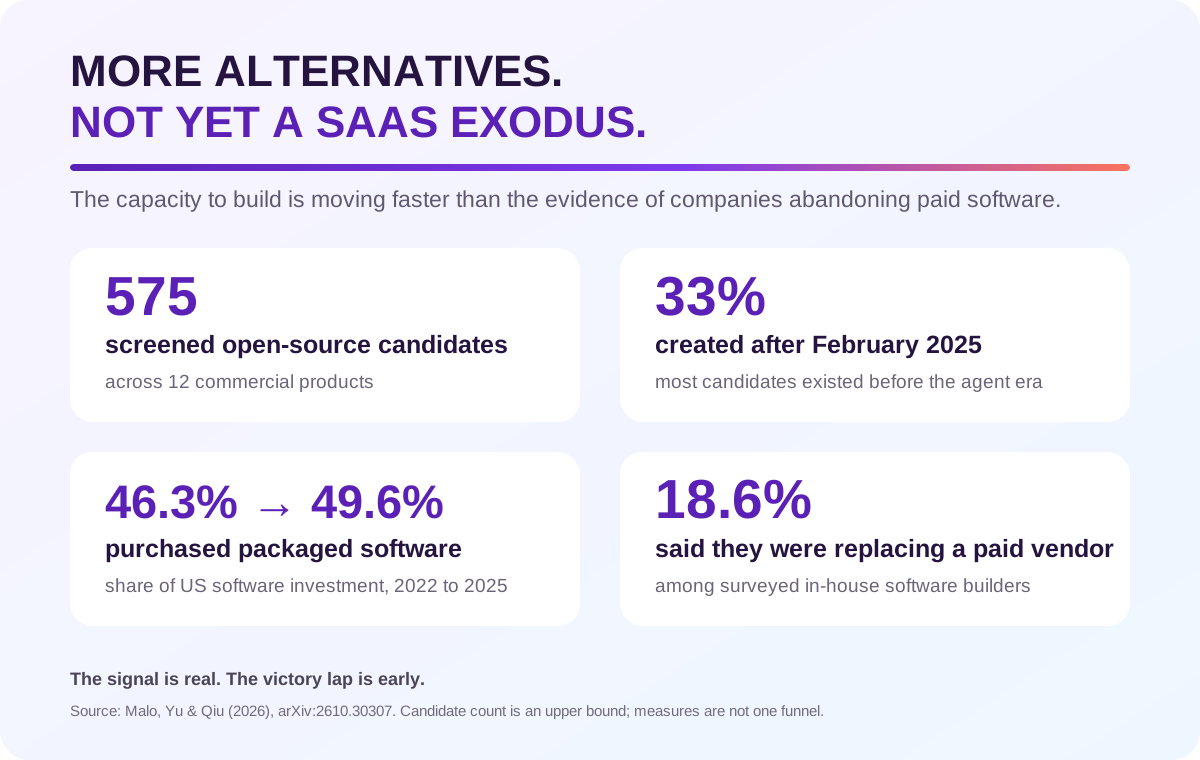
An October 2026 paper examined whether AI coding agents are changing the economics of buying software. The build side has changed. Broad buying behavior has not caught up.
- The researchers screened 575 potential open-source alternatives across twelve commercial products. They called that count an upper bound because some matches still need independent validation.
- Only 191 of those projects, or 33 percent, were created after February 2025.
- Purchased packaged software rose from 46.3 percent of US private software investment in 2022 to 49.6 percent in 2025. In-house software fell slightly.
- Among surveyed developers building software in-house, 18.6 percent said they were replacing a paid vendor.
The capacity to build is moving faster than the market's willingness to depend on what got built.
THE SAAS DEAD ZONE
I rail against the idea that SaaS is dead often enough that I should explain the nuance.
SaaS is not disappearing. I think it will thrive for plenty of good reasons. A vendor can spread development costs across thousands of customers. It can carry the hosting, security, upgrades, support, compliance work, and responsibility when something catches fire at 2 a.m.
The vulnerable sweet spot is where a small app and a small company overlap.
VULNERABLE
I have spent the last year walking straight into that overlap:
- I replaced Zoho CRM with Twenty.
- I replaced Buffer with Postiz.
- I replaced Google Analytics with Plausible.
- I replaced Senja with LoveWall.
- I replaced Featurebase with OpenDesk.
- I moved WordPress hosting to Jekyll and static websites.
The list keeps going.
One replacement is a preference. Six starts to look like a strategy.
It works because the migration surface is still bounded. I can understand the workflow, make the decision, accept the risk, and fix what breaks. AI cuts the time required to inspect the alternative, move the data, rebuild the integrations, and fill the gaps.
I would be much more cautious if the same software sat inside a company with thousands of employees.
At that scale, a "small app" may be attached to thousands of identities, years of permissions, SSO, audit requirements, custom integrations, training, procurement, compliance reviews, support expectations, data-retention rules, and workflows nobody has fully documented since 2019.
The app may be small. The blast radius is not.
A large company also cannot base the decision on one operator knowing how everything works and being willing to fix it. Ownership has to survive staff turnover, budget cycles, reorganizations, legal reviews, security incidents, and the person who approved the migration accepting a suspiciously well-timed position elsewhere.
Sometimes the SaaS subscription is buying software. At enterprise scale, it is often buying accountability and absorbing coordination cost.
Self-hosting can still win. It just stops being a clever founder migration and starts becoming an internal platform decision.
That is the nuance. SaaS is not equally vulnerable everywhere. It is exposed when the product is replaceable, the company is small enough to move, and one knowledgeable operator can take ownership without accidentally creating a new department.
THE BILL MOVED
Canceling the subscription can remove the license cost, the vendor lock-in, and whatever delightful pricing surprise was waiting at renewal.
It moves another list of jobs inside the company:
- hosting and monitoring;
- access control, backups, and upgrades;
- security and incident response;
- data migration and integrations;
- user support; and
- the decision to repair, replace, or retire the system.
NIST's Secure Software Development Framework is a useful antidote to the demo. Secure software requires organizational preparation, protected components, secure releases, and an ongoing response to vulnerabilities.
AI can help with those jobs. The company still owns the result.
Congratulations on the new product line. Its only customer is your own business, and that customer has your phone number.
RUN THE NUMBERS
Define the exact workflow and decide what "good enough" means before the migration begins.
Buying
- subscription price;
- integration;
- administration; and
- lock-in.
Building or adapting
- implementation and verification;
- migration and hosting;
- security and maintenance;
- support; and
- the expected cost of failure.
The research paper calls this the software substitution frontier. A workflow crosses it when the company can build or adapt an acceptable replacement for less than it costs to buy one over the same period.
AI can move that frontier. It cannot erase one side of the ledger.
This is the ownership problem I wrote about in AI creating accidental software owners, only at company scale.
Questions companies are asking about replacing SaaS with open source and AI
Does AI make open-source software cheaper to adopt?
It can lower the labor involved in evaluating a project, configuring it, writing integrations, migrating data, creating internal interfaces, and troubleshooting problems. It does not eliminate hosting, security, backups, upgrades, monitoring, support, or the cost of a failure. Compare total ownership cost over time, not just the speed of the initial migration.
Can open-source software replace SaaS?
Sometimes. The easiest target is a small, replaceable application inside a company that is still small enough to move quickly and accept ownership. The decision becomes harder as employee count, permissions, integrations, compliance requirements, training, and support expectations grow. SaaS may remain the better buy when vendor accountability and lower coordination cost are worth more than the subscription savings.
What is the difference between SaaS and self-hosted open-source software?
With SaaS, a vendor operates the application and sells access to it. With self-hosted open-source software, the source code is available under its license, but the adopting company usually becomes responsible for running, securing, updating, backing up, and supporting the system. Open source removes or changes the vendor relationship; it does not remove operations.
How should a company evaluate build versus buy software in the AI era?
Define the exact workflow and acceptance standard, then compare subscription and integration costs with implementation, verification, migration, hosting, security, maintenance, support, and expected failure costs. AI may reduce several build-side costs, but the decision is only better when the replacement remains dependable and less expensive over the period the company expects to use it.