
I love the strategy. The engine is another matter.
I Still Haven'tCracked Marketing
Research, positioning, and brand feel natural to me. Turning them into a running marketing engine does not.
I need to qualify the title
I love marketing.
More precisely, I love the strategic side of marketing. Give me a market to research, competitors to pull apart, a category to understand, and a brand to position. I can happily disappear into that work for an irresponsible amount of time.
I want to know what customers already believe, which competitor owns which idea in their minds, where the market is crowded, where it is weak, and what we can credibly claim. I enjoy deciding what a company should mean before we start shouting about it.
The part I have not cracked is turning that strategy into an engine that runs every week without me wondering whether somebody else would operate it much better.
Most software companies do not have a brand
They have a logo, a color palette, a UI kit, and a page of brand values nobody can remember. Somebody picked a purple gradient, rounded the corners, and declared the branding finished.
That is visual identity. A brand is the meaning and expectation a company earns in the market. It tells the customer who the product is for, what it stands against, why it deserves trust, and why choosing it should feel different.
Most software companies have no clue how to do that. Cover the names on their homepages and they collapse into the same company: a powerful, flexible, seamless, AI-powered platform that helps modern teams do more. The screenshots change. The company means nothing distinct.
I am a student of Al Ries and Jack Trout because their work on positioning attacks exactly this problem. The battle is not over who can list the most features or hire the trendiest design agency. It is over the position a company can occupy in the prospect's mind.
In their original articles on positioning, Ries and Trout argued that a company has to account for its own strengths and weaknesses as well as the positions competitors already occupy. Clever execution cannot rescue a company charging directly into a position somebody else owns.
I love these questions. Which category are we actually in? What do customers compare us with? What can we own? Which word, idea, or problem should bring us to mind? What should the brand look and sound like after we make those choices?
This is the part most software companies skip because choosing a typeface is much easier than deciding what the company will mean, and what it is willing not to be.
Then somebody has to turn on the engine
A positioning decision does not reach prospects through osmosis. Somebody has to choose the channels, build the campaigns, create the assets, maintain the calendar, manage paid programs, distribute the work, follow up, measure results, and then do it all again next week.
This is where I start feeling like an impostor.
I can do the tactical work. I have done it because founders eventually do nearly every job. But while I am doing it, I often have the nagging sense that a person who has run this exact kind of engine a hundred times would make better decisions, avoid obvious mistakes, and see possibilities I do not.
Knowing enough about marketing to see seventeen ways the execution could be better is not always comforting.
Tactical feedback gets noisy fast
Software gives me something solid to interrogate. The function works or it breaks. The server responds or it does not. Tactical marketing is less polite.
A campaign can fail because the channel was wrong, the creative was weak, the timing was bad, the offer was unclear, the list was tired, the budget was too small, or the experiment ended before repetition had a chance to work. It can also generate activity that looks terrific in a dashboard and produces absolutely nothing the company can spend.
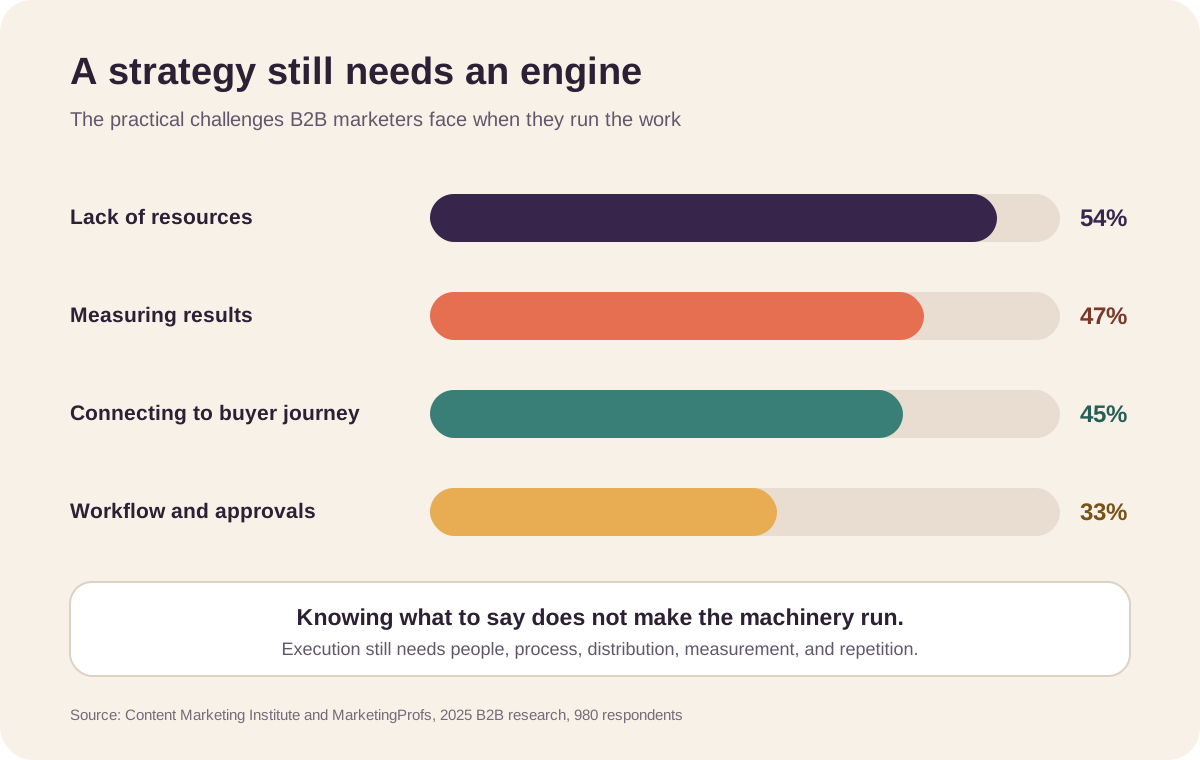
Content Marketing Institute and MarketingProfs surveyed 980 B2B marketers. Fifty-four percent cited a lack of resources as a challenge, 47 percent struggled to measure results, 45 percent struggled to connect content with the buyer journey, and only one in three reported having a scalable content-creation model.
Those are experienced marketers describing the engine. My discomfort is not proof that I misunderstand marketing. It may be a reasonably accurate reaction to a specialized operating discipline.
Building for marketers keeps me honest
Now I am building for digital marketers. I am not arriving as a stranger to marketing, but I cannot confuse strategic fluency with mastery of their craft.
I need to understand how the work happens after the positioning document is finished. Where does the process drag? What gets repeated? Which tools create more work than they remove? What does an experienced operator notice that I would miss?
That requires listening before performing expertise. SparkToro's audience research guide separates a broad market from the actual people a company needs to reach, including their behavior, sources of influence, and language. Interviews, community observation, support conversations, and audience data each reveal different parts of that picture.
The strategy work is familiar. Earning a detailed understanding of the people who operate the engine is the education.
AI can make the engine louder
Generative AI makes it absurdly easy to produce posts, emails, ads, and landing pages. We can now manufacture an impressive quantity of content nobody asked for.
It can help a skilled marketer test ideas and remove production bottlenecks. It can also help the rest of us be wrong at a previously unavailable scale. Volume does not tell me which idea deserves repetition, which channel deserves investment, or whether the campaign is building the position we chose.
HubSpot's 2026 survey of more than 1,500 marketers found that 83.5 percent were expected to produce more content, while measuring marketing ROI was the most commonly cited challenge. Apparently, making more things and knowing whether they worked remain separate problems.
Maybe I am not supposed to be the best operator
I still want to understand the machinery. A founder cannot hand somebody a vague instruction to "do marketing" and then act surprised when the result has no connection to the market, position, or brand.
But understanding the work does not require pretending I am the best person to perform every part of it. My job may be to own the strategic choices, give the operator a clear position to build from, recognize good work, and then get out of the way of someone better qualified to run the engine.
That feeling that somebody else could do the tactical work better may not be imposter syndrome at all. Sometimes there really is someone better qualified. The useful skill is knowing when to bring them in without surrendering the strategy that gives their work direction.
Questions SaaS founders ask about marketing strategy and execution
What is the difference between marketing strategy and marketing tactics?
Marketing strategy decides which market to pursue, which customer to serve, how the brand should be positioned against alternatives, and what it should mean in the buyer’s mind. Marketing tactics turn those decisions into campaigns, content, advertising, email, events, distribution, and measurement. Strong execution cannot rescue a confused position, but a good position still needs consistent execution to reach the market.
Should a SaaS founder do their own marketing?
Founders should stay close to the customer, market research, positioning, and brand decisions, especially early. That does not mean the founder must personally master every channel or operate the marketing engine forever. A specialist may be better qualified to plan campaigns, manage distribution, run paid programs, and build a reliable reporting cadence.
How do you turn a SaaS marketing strategy into a tactical plan?
Translate the position into a defined audience, a small number of messages, specific offers, selected channels, a publishing and campaign cadence, named owners, and measures tied to customer action. Keep the first plan narrow enough to run consistently. Review what happened, but do not change the underlying position every time one campaign disappoints.
When should a SaaS startup hire its first marketer?
Hire when the company understands its customer and position well enough to give a marketer useful direction, and when tactical execution has become too specialized or time-consuming for the founder to run consistently. Hiring before those strategic decisions exist can leave the marketer responsible for inventing the market as well as operating every channel.