

The road map does not need another "tiny" feature
The Founder Skill Nobody Celebrates:Knowing What Not to Build
Shipping gets the applause. Saying no keeps your product from becoming a junk drawer with a login screen.
Good ideas cause most of the trouble
Nobody walks into a road map meeting and says, "I have a catastrophically stupid idea that will waste six months." Obviously bad ideas are easy to reject. The dangerous ones could work. A customer wants them. A competitor has them. The build looks small. Somebody can make a convincing case that revenue might follow.
Founders are trained to treat motion as virtue, so saying yes feels productive. A new item enters the road map, the team starts building, and everybody gets the satisfaction of progress.
What disappears is harder to see. The core workflow receives less attention. Positioning becomes harder to explain. Support inherits another path to understand. Every future change has one more dependency. Congratulations, the two-day feature now has a permanent seat at the table.
The estimate ends at launch. The cost does not.
"It is only a two-day build" may be the most expensive sentence in software. A feature that takes two days to code can live for ten years. It needs permissions, documentation, testing, analytics, support, security review, migrations, and decisions about every adjacent feature that follows.
AI makes the first cost smaller. That is useful, but it also removes the friction that used to force the prioritization conversation. "We can build it quickly" is now an especially weak argument because the enduring cost was never just the typing.
The honest question is not whether the team can ship it. Of course it can. The honest question is whether the company wants to feed, house, support, and explain the thing for the rest of its natural life.
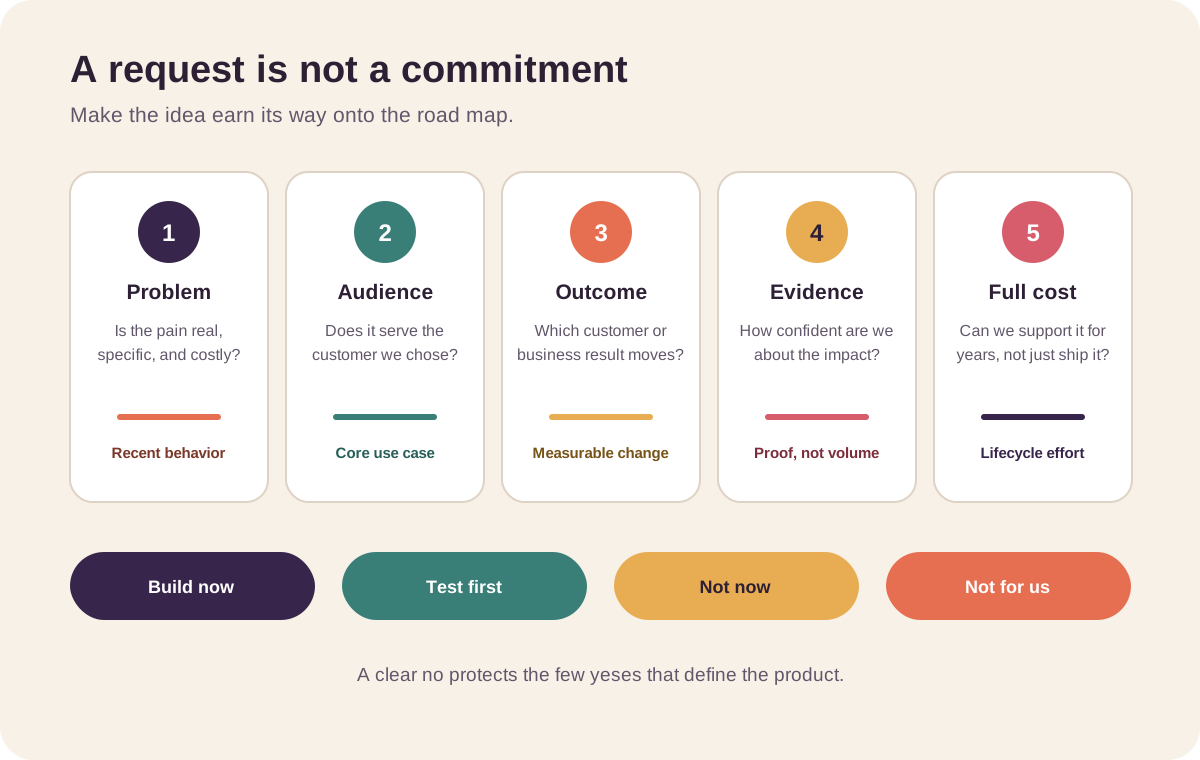
Make the request earn a place
A customer request is evidence that one person said something. It is not a road map subpoena. It tells you nothing yet about frequency, urgency, willingness to pay, or strategic fit.
First, understand the event behind the request. What happened? How is the customer handling it now? What does the workaround cost? Who else has the same problem? Then ask whether solving it makes the product more valuable to the market you chose or merely more specific to one account.
Intercom's RICE framework forces teams to consider reach, impact, confidence, and effort. Its greatest value is not the final number. It is the discomfort of admitting when enthusiasm rests on weak evidence.
A fixed appetite improves the design
Estimates ask how long a proposed solution will take. An appetite asks how much time the problem deserves. That reversal prevents the first imagined solution from dictating the investment.
Basecamp's Shape Up method calls this fixed time and variable scope. Constraining the appetite makes the team distinguish what is central from what is merely attractive.
That is not the same as shipping something careless. It means choosing the smallest complete change that creates the intended result, then leaving the rest behind.
Low-effort work can still be expensive
Founders love small wins because they are easy to start, easy to demonstrate, and easy to defend. Do enough of them and you can fill every week, exhaust the entire team, and leave the trajectory of the company completely untouched.
Intercom calls low-effort, low-impact work "snacking". The individual task looks harmless. The pattern is not. A team can become highly efficient at work that does not matter.
A useful road map contains explicit rejections. Not now. Not until we see evidence. Not for this customer. Not for the company we are trying to build. If nothing is being declined, you do not have a strategy. You have a waiting room.
Questions founders ask about feature prioritization
How should a SaaS startup prioritize feature requests?
Start with the customer problem, not the requested solution. Evaluate how many core customers experience it, how serious the consequence is, which business outcome would change, how strong the evidence is, and the full cost to build and support the feature. Use a scoring framework to expose assumptions, not to replace judgment.
When should you say no to a customer feature request?
Say no when the request serves an edge case outside the target market, conflicts with the product’s direction, lacks evidence of meaningful impact, or creates a support burden that the likely value cannot justify. A respectful no should explain the problem you are choosing to solve and leave room for new evidence.
How do you prevent feature creep in a SaaS product?
Give every project a defined customer problem, desired outcome, time appetite, and explicit boundary. Separate must-haves from nice-to-haves during development, and require new scope to displace something else. Review what was added after each release so recurring sources of creep become visible.
What is the best feature prioritization framework for a startup?
There is no universal best framework. RICE is useful when you can estimate reach, impact, confidence, and effort. A simpler problem, audience, outcome, evidence, and full-cost screen may work better with limited data. The important part is applying the same questions consistently and recording why exceptions were made.