
The buyer will not wait while you find the paperwork
Operate Like a Real CompanyBefore You Feel Like One
The call can come before you feel ready: "We're interested in buying you." The company you can prove is the company you can sell.
The call does not arrive on your schedule
Most founders imagine selling the company as a decision they will make someday, once everything is polished and the timing feels right.
That is a comforting fantasy.
The real call can arrive in the middle of a messy quarter. A larger company noticed the product. A competitor wants the customers. Someone sees strategic value you did not know was visible. The opening sentence is exciting: "We're interested in buying you." The next conversation is considerably less romantic.
Can you send three years of financials? Customer contracts? The cap table? Churn by cohort? Vendor agreements? Security policies? Proof that every employee and contractor assigned their intellectual property to the company?
At that point, "I am pretty sure we have it somewhere" is a terrible answer.
Cooley's guidance for companies preparing for an M&A exit makes the timing problem plain: once a buyer is interested, transactions can move quickly. The records need to be ready before the request arrives.
Time is the killer of deals
Every extra week creates another opportunity for something to change. Revenue slips. A large customer churns. The buyer's priorities move. A different acquisition appears. Someone on the buyer's side gets nervous. The people involved get tired of talking about the deal and start wondering whether they should be doing it at all.
The problem with missing records is not merely that they look sloppy. They consume time, and time gives uncertainty room to grow.
McKinsey's analysis of delayed acquisitions focuses on much larger deals, but the damage it identifies is familiar at any size: delays erode value, distract the people running the business, weaken momentum, and exhaust everyone involved.
A buyer may accept a known problem. A buyer can price a known risk. What buyers hate is discovering that every answer produces two more questions.
A buyer is not buying your explanation
Founders get very good at explaining why things are the way they are. The books are a little unusual because of that annual contract. The contractor definitely agreed that the company owns the code. The cap table is accurate once you understand which spreadsheet to ignore. The security process exists, although nobody has written it down.
None of this sounds reassuring during diligence.
A buyer is trying to determine what it owns, what it owes, what could break, and whether the story told during the courtship survives contact with the records. Deloitte says a prepared seller can answer diligence questions faster, strengthen credibility, and reduce disruption to the operating business.
That credibility is part of the value. Clean records tell the buyer that the rest of the company may also be what you said it was.
You cannot recreate clean history under pressure
You can create a policy next week. You cannot honestly create evidence that the company followed it for the last three years.
The same is true everywhere else. You cannot go back and get an intellectual-property assignment from a contractor who has disappeared. You cannot reconstruct every approval from Slack archaeology. You cannot make an unsigned customer agreement become signed by putting it in a very organized folder.
Orrick recommends setting up the data room early so sellers can identify and fix problems before buyer diligence begins. Its broader technology M&A guidance warns that uncertainty about intellectual-property ownership can delay or derail a transaction or reduce its value.
This is why you protect the exit from the beginning, even when you have no current plan to sell. Get signatures. Keep board and equity records current. Store contracts where somebody other than the founder can find them. Know who owns the code. Do the boring work while it is still boring.
Founder math will not survive diligence
An annual SaaS payment feels like revenue because the cash is sitting right there. Accounting does not care how emotionally available the money seems.
Under ASC 606, companies identify the contract and performance obligations, determine and allocate the price, then recognize revenue as those obligations are satisfied. FASB's revenue recognition overview explains the standard and its history.
Contract details matter. Deferred revenue matters. Consistent reporting matters. Do not wait for a buyer's quality-of-earnings team to discover that the revenue schedule depends on a spreadsheet named final-revenue-v7-USE-THIS-ONE.xlsx.
Clean books let the buyer understand the company faster. They also reduce the chance that an avoidable surprise becomes a price reduction, another condition, or a reason to walk.
SOC 2 is useful rehearsal
AICPA describes SOC 2 as an examination of controls relevant to security, availability, processing integrity, confidentiality, or privacy. In normal founder language, an outside party is going to ask the same rude question over and over: can you prove it?
Your first audit may still feel like a slow death. Good operating habits determine whether it is merely painful or a full-scale apocalypse. More importantly, those habits teach the company to preserve evidence before acquisition diligence puts far more than a certification at stake.
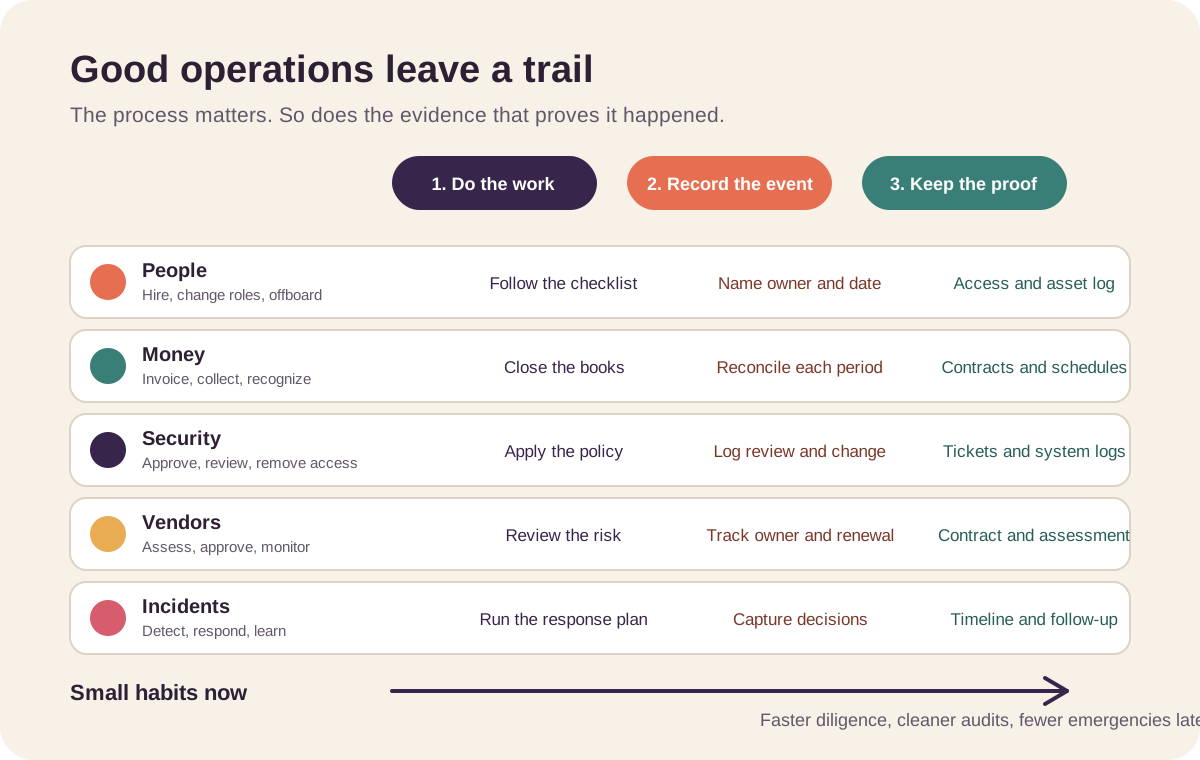
A SOC 2 report is not acquisition readiness by itself. It will not clean the cap table, find missing contracts, fix the books, or establish ownership of the software. It does help build the reflex a seller needs: do the work, record the event, and keep the proof.
Build the exit path while you build the company
You do not need to run a five-person SaaS company like General Electric. You do need a reliable home for the records that explain what the company owns, owes, earned, promised, protected, and approved.
Keep the system simple. Update financials and revenue schedules every month. Store signed customer, vendor, employee, and contractor agreements. Maintain the cap table and corporate approvals. Record material security events and access changes. Keep policies honest enough that the team can follow them.
This does not mean exposing sensitive material in a permanently open data room. It means keeping the underlying records organized and involving qualified legal, accounting, tax, and security advisors when an actual transaction becomes possible.
You may never sell. Fine. The same habits make the company easier to operate, finance, audit, and survive. But if that call does come, you will not be trying to build three years of credibility in three weeks.
Questions founders ask about preparing a SaaS company for acquisition
How do I prepare my SaaS company for acquisition?
Run the company so its important claims can be verified quickly. Maintain accurate financial statements and revenue schedules, signed customer and vendor contracts, current cap-table records, employee and contractor agreements, intellectual-property assignments, security policies, access records, and documented operating procedures. Review the material regularly instead of assembling it after a buyer calls.
What documents do buyers request when acquiring a SaaS company?
Requests vary by buyer and transaction, but diligence commonly covers financial statements, tax records, revenue and customer metrics, customer and vendor agreements, corporate records, capitalization, employment arrangements, intellectual-property ownership, technology, security, privacy, litigation, and regulatory compliance. Legal and financial advisors should tailor the list to the company and proposed transaction.
When should a startup prepare an M&A data room?
Keep acquisition-relevant records organized from the beginning, then establish a formal, access-controlled data room when an exit becomes realistic or advisors recommend it. Preparing early exposes missing signatures, ownership problems, and inconsistent records while there is still time to fix them. Sensitive information should only be shared under appropriate legal guidance and access controls.
Does SOC 2 help when selling a SaaS company?
A SOC 2 report does not guarantee a sale, but the habits behind it can make security diligence easier. Buyers may still examine policies, access controls, incident history, vendors, data handling, and evidence that controls actually operated. Even without a completed SOC 2 examination, consistent security records reduce the amount the company must reconstruct under deal pressure.
Sources and further reading
- Cooley GO, Prep to Sell: Getting Ready for an M&A Exit
- Orrick, Tech Exit Series: Preparing a Data Room
- Deloitte, Diligence and Sell-Side Advisory Services
- McKinsey & Company, Navigating Delays in M&A Deals
- AICPA & CIMA, SOC 2 Trust Services Criteria Resources
- FASB, Revenue Recognition Project Summary