
Nobody woke up hoping to buy another dashboard
Nobody Wants Your Software.They Want the Problem Gone.
Customers do not want software. They want one irritating, expensive problem to stop ruining their Tuesday.
Founders see proof of work
Every feature has a dramatic backstory inside the company. Someone argued for it, designed it, built it, broke it, fixed it, documented it, and dragged it across the finish line. By launch day, we are emotionally invested. Look at this beautiful thing. Do you have any idea what it took to make the permissions work?
The customer does not care. They see another screen, another login, another implementation, and another vendor asking for money.
That is why a technically impressive product can be strangely difficult to sell. The founder is proudly presenting an accomplishment. The buyer is quietly calculating whether the problem is painful enough to sit through another onboarding call.
The customer started somewhere else
The customer did not wake up hoping to buy a dashboard. Something happened. A handoff failed. A report took three days. An important request disappeared into a shared inbox. An audit exposed a mess. A customer became angry. A manager got tired of asking the same question every Friday and receiving seven slightly different spreadsheets.
The Christensen Institute's Jobs to Be Done theory describes products as things people pull into their lives to make progress in a particular circumstance. That circumstance explains the purchase better than the product category or a list of attributes.
For SaaS, the ugly workflow and its consequence come first. The software is merely how the mess stops happening.
Make every feature survive "so what?"
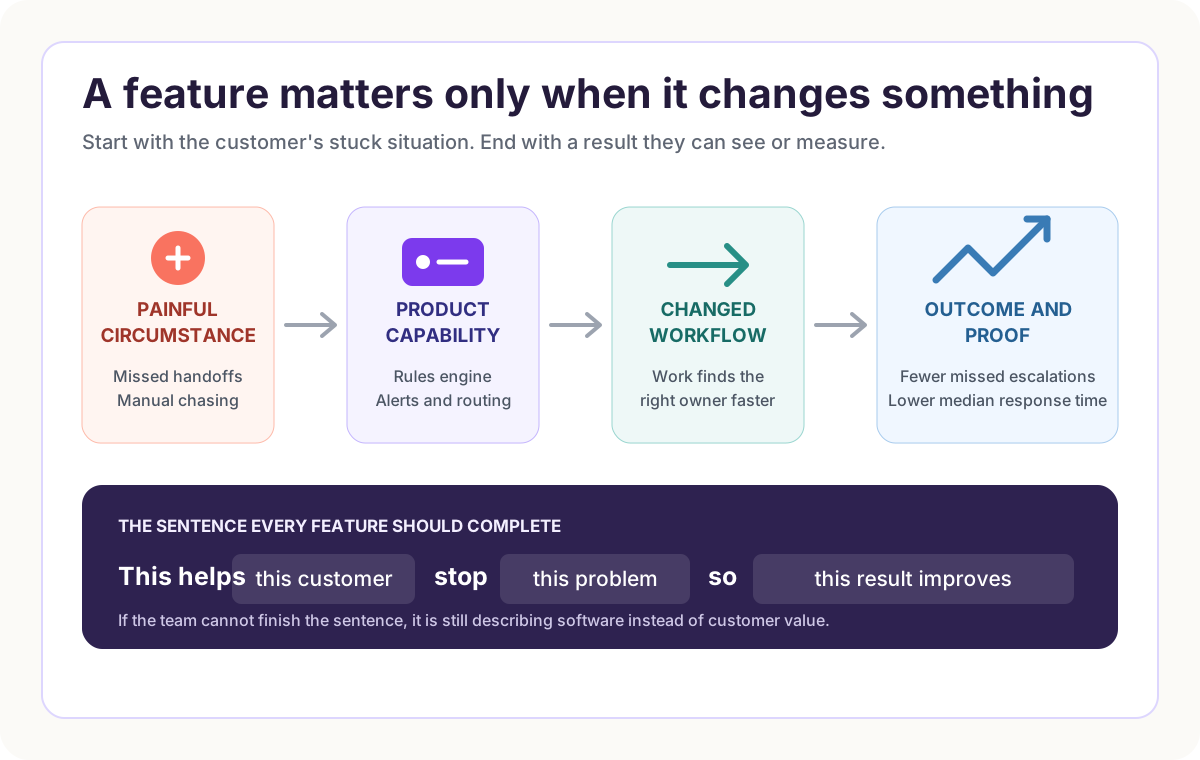
Automated routing is a feature. Less manual triage is a benefit. Fewer missed escalations and a shorter response time are outcomes.
Those distinctions sound obvious until you read most SaaS homepages. "Advanced analytics," "seamless integrations," and "AI-powered automation" describe the product while leaving the buyer to do the hard part: figuring out why any of it matters.
A good explanation completes the chain: this capability changes this part of the workflow, which improves this result, which matters because the current problem costs the customer time, money, trust, or control.
Vague benefits are features wearing nicer clothes
"Save time" and "streamline operations" are features wearing a blazer. Almost every software company can say them, and neither tells the buyer what will actually change.
Ask how the customer measures the problem now. Minutes to first response. Hours spent reconciling reports. Incidents missed. Deals delayed. Days required to onboard an employee. It does not always need to become a perfect ROI calculation, but it should be concrete enough that the buyer can recognize improvement.
Strategyzer recommends focusing on customer jobs that are important, tangible, unsatisfied, and economically attractive. That is a better road map filter than the number of times a feature was requested.
The outcome also changes the product
Outcome language is not marketing cologne sprayed on the product after development. If the desired result is fewer missed escalations, the product needs reliable routing, clear ownership, useful alerts, auditability, and reporting that proves the improvement. A beautiful dashboard that does not change the handoff is decoration.
Clayton Christensen and his coauthors argued in Harvard Business Review that companies struggle when they collect data about customers without understanding why those customers make a choice. The same mistake happens when a product team measures feature use without asking whether the customer's situation improved.
The problem should shape the message, the road map, onboarding, support, and the proof you show at renewal. If it only appears in the headline, you are not selling an outcome. You are decorating a feature list.
Questions founders ask about selling SaaS outcomes
How do you sell SaaS outcomes instead of features?
Begin with the customer’s current problem and its cost. Explain the workflow change your product creates, then connect that change to a result the buyer already measures. Features belong in the proof. They should not force the buyer to invent the business case for you.
What is the difference between a SaaS feature and a benefit?
A feature is something the product does, such as automated routing. A benefit is the improvement that capability creates for the user, such as less manual triage. An outcome is the business result, such as faster response times or fewer missed escalations.
How do you identify real customer pain points?
Ask customers about recent events, current workarounds, delays, errors, risks, and the consequences of leaving the problem alone. Look for pains that are frequent, expensive, visible to management, or tied to an existing budget. A complaint is more useful when it changes behavior.
Do customers care about software features?
Yes, after they understand why the product matters. Features help buyers compare options, evaluate fit, and trust that a promised outcome is achievable. A feature list without customer context asks the buyer to do too much translation and usually makes the product easier to compare on price.