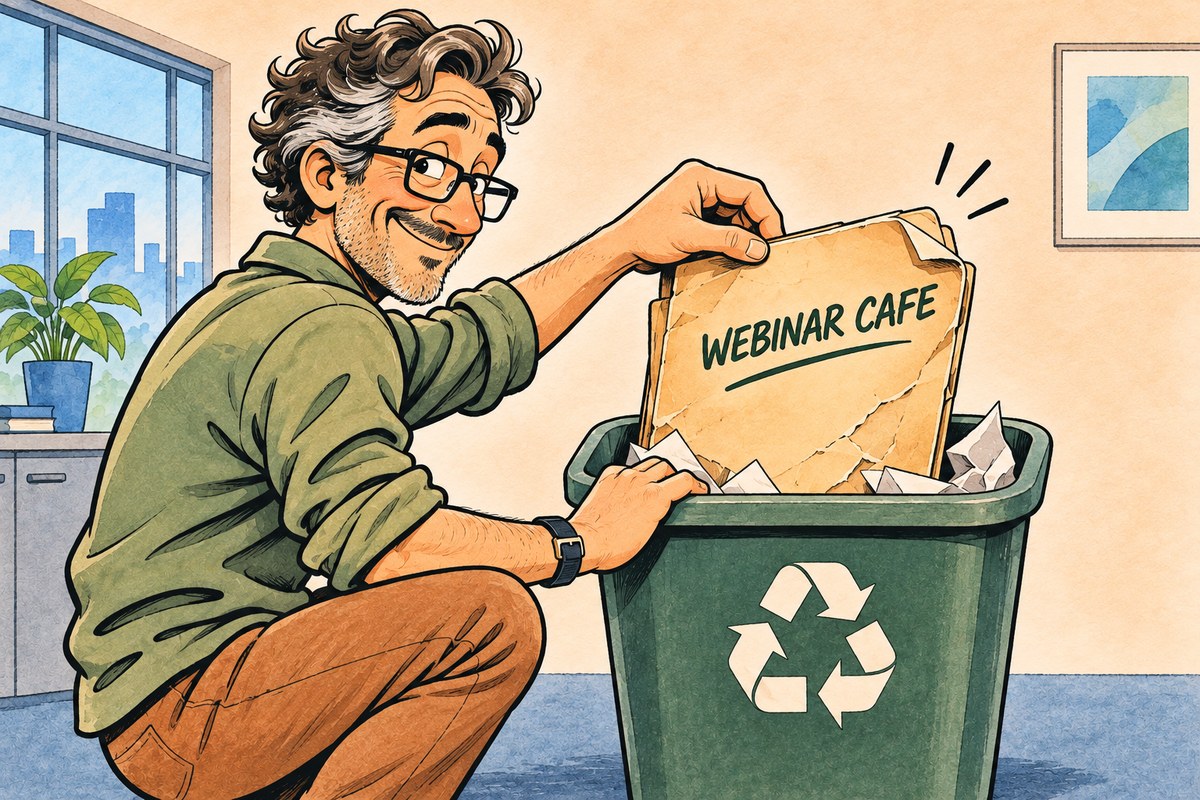
An old idea. A changed constraint.
I couldn't let this idea go. Now I can finally test it.
I automated the work that kept Webinar Cafe from growing. Now I have to find out whether anyone wants the business.
I wrote an article about knowing what not to build. Naturally, I'm now rebuilding a product I couldn't quite bring myself to give up on.
The product is Webinar Cafe. It got off the ground the first time. What it never got was enough exposure to tell me whether I had a business worth growing.
I spent too much of my time keeping it populated.
A webinar directory needs new webinars every day. Finding them, figuring out where they belong, and getting useful details into the repository became the work. The audience I needed to build kept waiting behind tomorrow's listings.
Now I've automated that daily process. I also have ways to find and reach the publishers, communities, and prospective attendees that need to come together for this to work.
Perhaps the idea deserves another chance because something meaningful has changed. Or perhaps I've found a more sophisticated way to justify hanging on to it.
A founder who still likes an old idea can be remarkably persuasive when the audience is himself.
What I was trying to build
Webinar Cafe helps people discover webinars across publishers and topics, then sends them to the publisher to register.
You might know what you want to learn without knowing which company, association, or specialist is hosting a useful session about it. If you're already on the right mailing lists, you may hear about it. Otherwise, the event can come and go without reaching you.
I want someone to be able to browse a subject, find an upcoming session, and decide whether it's worth their time. Topic and publisher subscriptions can help them keep up without repeating the search themselves.
For a publisher, the problem runs in the other direction. You've put work into an event. You need to reach people who might benefit from attending, including people outside your existing audience.
Those are the two sides I'm trying to bring together.
Tomorrow's listings kept winning
The first version gave me an operating problem before I had solved the distribution problem.
Keeping the directory current was necessary. An empty calendar isn't much of a recommendation. Doing that work manually left too little time to get the directory in front of people.
I never reached the level of exposure I wanted.
That doesn't establish that marketing was the only thing wrong. It doesn't prove people were waiting for Webinar Cafe and simply couldn't find it. I don't have that evidence.
It explains why I never felt finished with the idea. I could see a constraint consuming my time, and I couldn't get far enough past it to test the rest of the business properly.
Discovering that customers don't want something and spending your available hours maintaining it before enough customers see it can both end with a quiet website. They leave you with different questions.
This time, I can name what changed
The daily work of finding and populating webinars is now automated. I can put sustained time into audience development and publisher relationships.
AI gives me practical help with the promotion work around the business, too. Researching relevant audiences, preparing material for different channels, and organizing outreach no longer have to depend entirely on the time left after the directory is current.
There is still judgment involved. An event has to belong in the topic where it appears. The description has to be accurate. Promoting a session to people who have no reason to care doesn't become useful because I can do it faster.
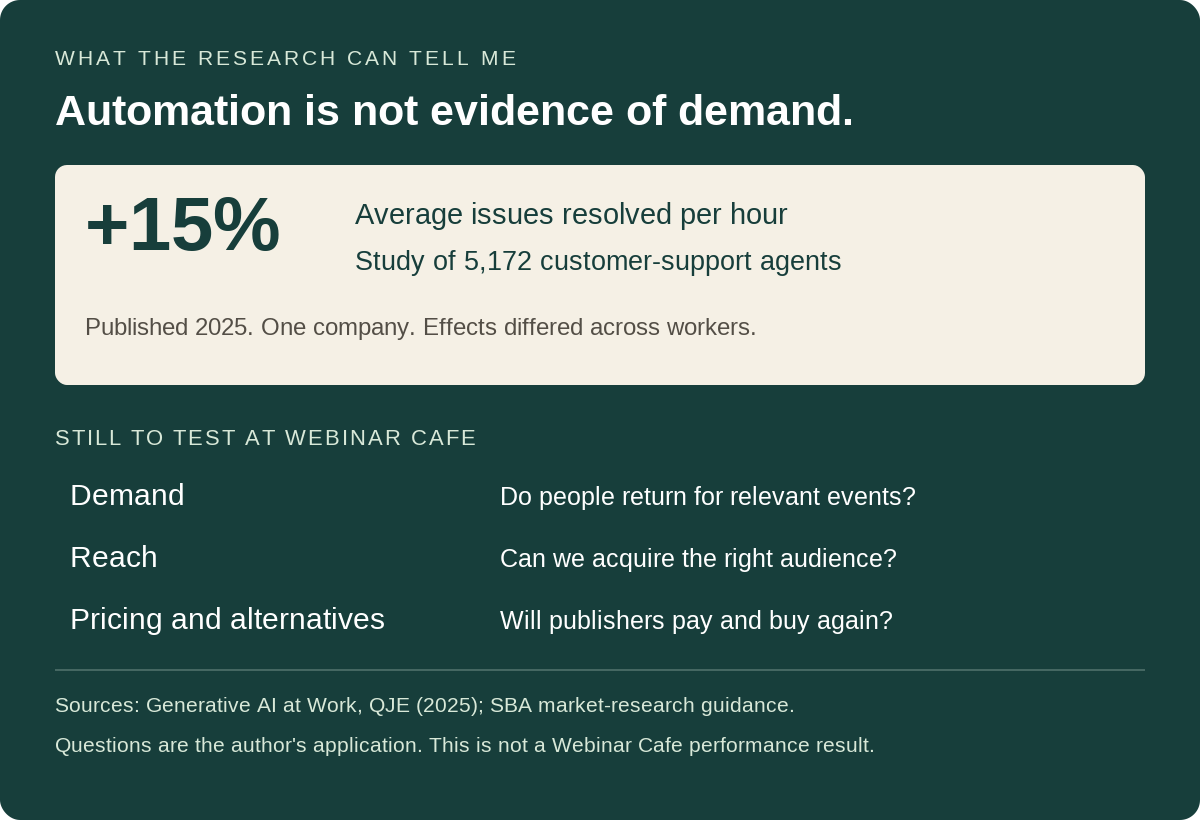
There is evidence that AI can change the economics of recurring work. In the published study Generative AI at Work, Brynjolfsson, Li, and Raymond studied 5,172 customer-support agents. AI assistance increased issues resolved per hour by 15% on average, with substantially different effects across workers.
That was customer support at one company. It does not tell me how much time Webinar Cafe saves, whether anyone will visit, or what a publisher will pay. It supports a narrower point: a specific workflow can become more productive. The business still needs customers.
I'm revisiting this idea because I can identify the recurring work that changed. A nicer website would be a much weaker excuse.
The directory is the beginning of the offer
I see a broader service opportunity than I pursued the first time.
A company promoting an upcoming webinar needs relevant people to see the event while there's still time to attend. A listing can help, but I want Webinar Cafe to do more of that work.
My initial plan includes:
- Featured listings on Webinar Cafe.
- Social media promotion of upcoming events.
- Engagement in relevant communities.
- Highly targeted paid social advertising campaigns to drive traffic.
Featured placement gives publishers visibility within the directory. The other services help them reach audiences elsewhere.
That's how I intend to monetize the business: help companies promote webinars, with the directory providing part of the audience and the service extending beyond it.
These are the starting plans. I haven't established what every campaign will deliver. Traffic, registrations, and attendance need to be measured, and a promotion service has to earn the next purchase.
The publisher has a dated event and a limited window in which promotion can help. I think there is a service worth selling there. Now I have to demonstrate it.
A directory doesn't get a network effect for showing up
I'm increasingly interested in businesses that bring people together or deliver a service beyond access to software. Webinar Cafe gives me a way to pursue both.
More relevant events can give people a reason to visit and subscribe. An audience that finds those events useful can give publishers a reason to participate. Helping a publisher reach prospective attendees gives us a commercial relationship to develop.
That's the effect I want to create. Calling it a network effect doesn't establish that it's happening.
I'd rather find out whether someone who discovers a useful webinar comes back for another one. Getting a company listed once is also different from becoming part of how it promotes future events.
My audience-building plan starts with useful inventory in specific topics, relationships with recurring publishers, topic subscriptions, and promotion in places where the subject already matters. Search can help people find those topic pages. Social and community participation have to give people something relevant to act on.
Automating supply gives me a better chance of keeping that destination useful while I work on distribution.
The research still has to happen
The U.S. Small Business Administration's market-research guidance asks about demand, market size, where customers can be reached, competing alternatives, and pricing. None of those questions disappears because I can automate the listings.
For Webinar Cafe, I need to learn which topics people return for, how they discover the site, and whether publishers see enough value in promotion to buy it again. Activity in the repository won't answer those questions.
This is the same discipline I argued for in researching the market before launch. Revisiting my own idea doesn't earn me an exemption.
Before returning to an old product, I'd write down the constraint that stopped it, what has changed, and the customer behavior I can now test. If the explanation stops at "AI makes it easier," I'd keep writing.
I don't need a model to tell me that my idea is brilliant. I can manage that particular mistake without assistance.
I still have to be willing to stop
I think the circumstances have improved. I think the promotion service has value. I think I can now do work that was impractical for me before.
I could be wrong about how much those changes matter.
If Webinar Cafe stays populated but people don't return, I've made it easier to operate a directory that hasn't earned an audience. If publishers like the idea but won't pay for promotion, I haven't established the business model.
I need to learn those things without treating every disappointing result as a request for another feature. My own article about knowing what not to build should be particularly inconvenient reading at that point.
The daily inventory work no longer has to consume the business. I can put sustained effort into getting relevant people to the events and helping publishers promote them.
That's enough of a change for me to try again.
I don't get to use the same explanation if it doesn't work this time.
Questions about revisiting a business idea with AI
When should you revisit an old business idea?
Revisit it when you can identify a constraint that has materially changed and explain which customer behavior you can now test. Cheaper development alone does not establish demand or willingness to pay.
Can AI automation make an old business idea viable?
It can reduce the recurring work that previously made a business difficult to operate. Viability still depends on demand, customer acquisition, delivery costs, and revenue. Webinar Cafe is the author’s attempt to test that distinction, not a demonstrated success story.
What is Webinar Cafe?
Webinar Cafe is a directory that helps people discover webinars by topic and publisher. Visitors go to the publisher to register. The goal is to connect relevant events with people who might otherwise never discover them.
How does Jasen plan to monetize Webinar Cafe?
The initial plan combines featured listings with webinar promotion services: social media promotion, engagement in relevant communities, and targeted paid social advertising campaigns. Service packages, pricing, and campaign outcomes are not established in this article.